How are they doing now: Chainable
In this new series, we speak with producers and manufacturers we have spoken to before. How is the company doing, how is the product doing, and what added value has registering the product in the NMD brought?
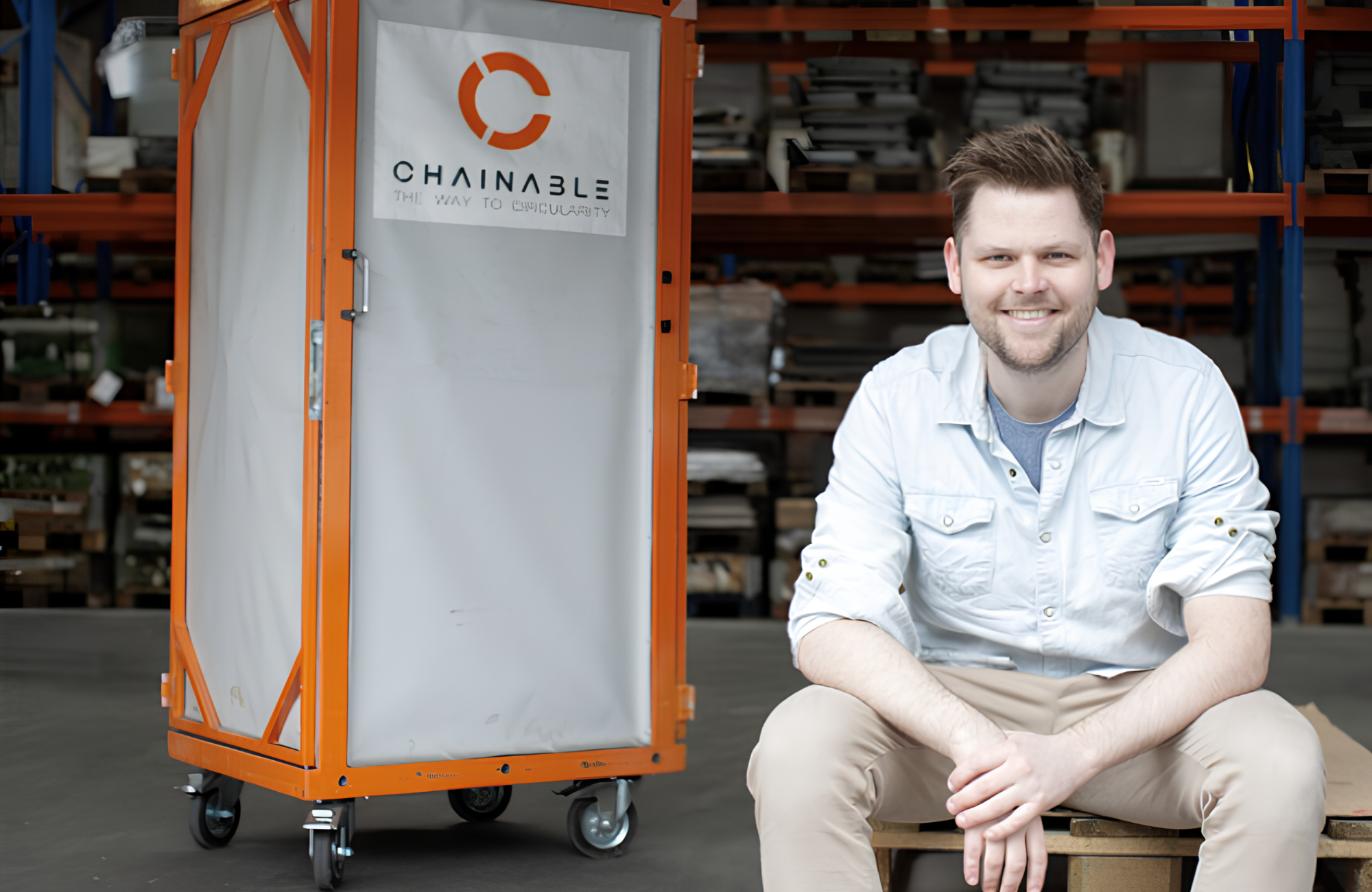
In this first instalment, we spoke with Simon Rombouts, co-founder and director of Chainable. We previously spoke with Simon about the rise of the circular kitchen in April 2022.
At that time, Chainable had been working for a year and a half on bringing its Kitchen as-a-service concept to market. Four and a half years later, Chainable has grown from a start-up into a scale-up. The Chainable kitchen has been in the Dutch Environmental Database since May 2023.
What has changed since then?
Growth & scale
You have grown from a start-up into a scale-up. Was there a moment when you noticed Chainable crossing that line?
“There isn’t really a single moment when that happens. It’s more of a process. As a start-up, the market still expects that there might be the occasional mistake in the kitchen. But when you deliver 50 kitchens a week, you can’t afford mistakes anymore. We have scaled up by a factor of 6. We currently have 28 FTE, whereas in 2022 I believe we were with 8 people. We now produce 1,200 kitchens per year, which was 200 back then.
A clear moment of growth was the investment injection of 1.4 million euros at the end of 2023. The same investors later made a follow-up investment, in which all shareholders also took part. That helps enormously with the growth of your company. The brand awareness that we are synonymous with a circular kitchen is also an indication that we are clearly no longer a start-up.”
You are now in a larger building. What made that move necessary?
“We moved on June 15th this year. We outgrew our previous building. In terms of office space, but especially warehouse space. The building we are in now is two and a half times as large as our previous one. It was a bit nerve wracking for the staff when they knew we had to move. We looked everywhere for a suitable commercial building. But we also knew that if we moved further away, we wouldn’t be able to bring all our staff with us. When we could announce at last year’s Christmas drinks that we would be staying on the same street, a sigh of relief went around the room.
But in the old warehouse, we no longer had room to separate incoming and outgoing products. At that time we had 400 pallet positions and 1 loading and unloading door. Now we have 1,200 pallet positions and 5 loading and unloading doors. That makes the whole logistics process a lot easier.”
How has the team grown along with the company, and what is different in the team composition now?
“To safeguard the professionalisation of your company, at some point you have to add a management layer. Managing 10 people is fine, but with more it becomes difficult. We have grown in both office based and field staff. We also now have our own IT department. They are responsible for the materials passport, for example. With that passport, every kitchen has a digital copy in which you can see the CO2 footprint at component level.”
Production & product
Has the production process changed since the previous interview?
“Mainly the materials have improved. We work with the Belgian wood recycling company Unilin. The boards consist of 92% reclaimed wood and 8% pruning and roadside verge waste. They have been making boards from used wood since 1980. This is a very high quality particle board that would normally require trees to be felled. In addition, we have little cutting loss, because Unilin makes boards in different sizes for us. The cutting loss, incidentally, goes back to the factory.”
In 2022 you talked about a steel frame and modular worktops as the basic concept. Has anything changed there?
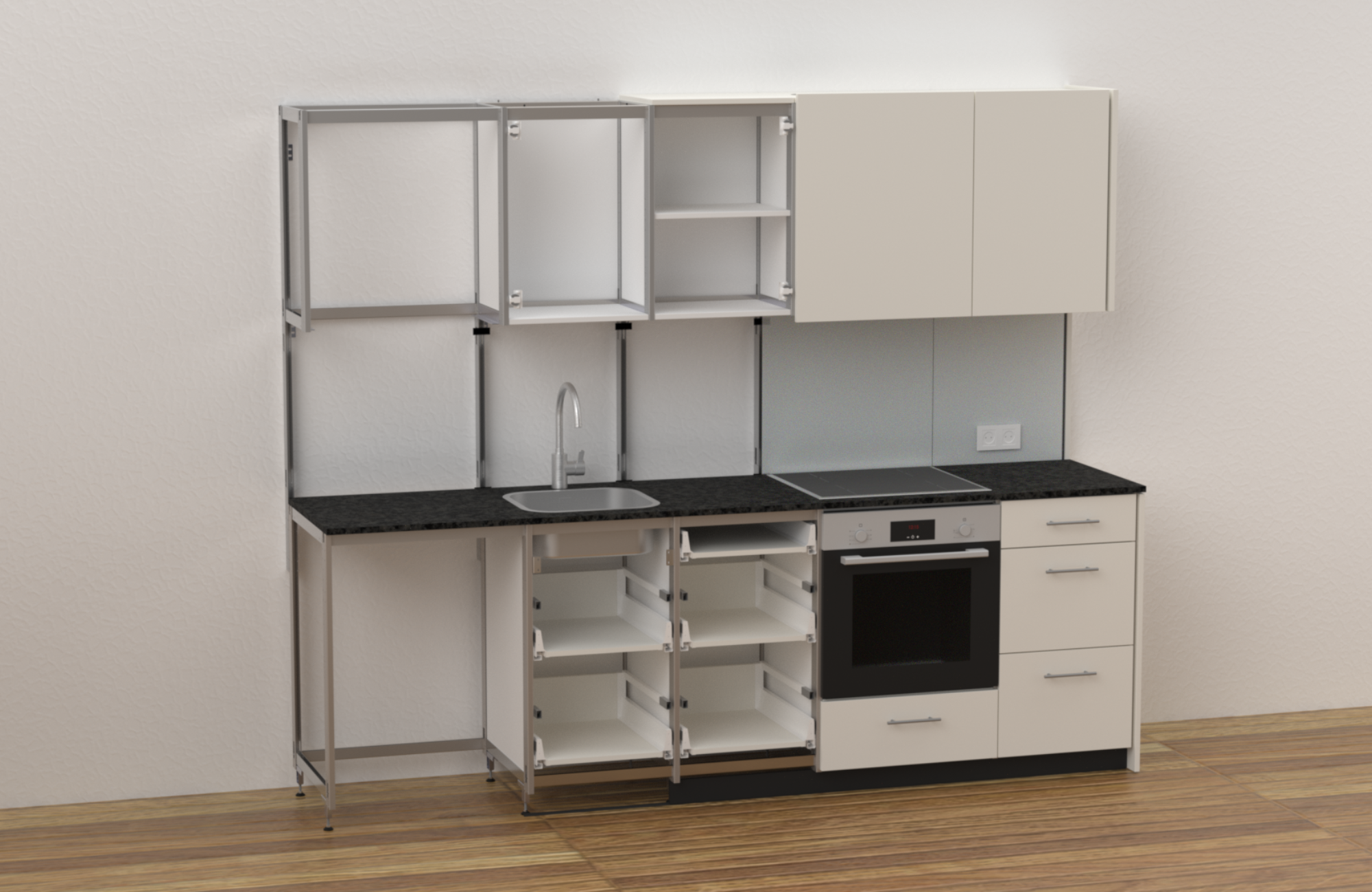
“The basic concept has remained the same, but the frame has clearly been further developed. We now use 43% less steel. This makes the kitchen much lighter and gives it even less impact on the environment. We have tested the frame and it still has the same strength and a high degree of robustness. In 2022 we had a circularity score of 79-82%, now it is 90%.”
At the time, you wanted to reach a higher step on the R ladder. Did you succeed?
“Yes, we did. That has mainly to do with demountability. We use 30 to 40% less board material than in a traditional kitchen. We have adjusted some boards from 18mm to 16mm, and other boards from 16mm to 10mm. The components can all be easily detached and therefore adapted, replaced or reused. The back panels and partition walls can also be detached separately. This means all individual parts of a kitchen can be replaced or refurbished without having to replace an entire kitchen. Only when a component can no longer be repaired or refurbished is it recycled, and therefore not incinerated.”
Environmental data & NMD
At the time, you developed an EPD with Alba Concepts. Where does that process stand now?
“Our kitchen has been in the NMD since May 2023. In January 2027, we are starting a new LCA process, because at the moment not all improvements to the product are reflected in the environmental data in the NMD. Because this is a lengthy and costly process, we hadn’t done it earlier. We do have the Product Circularity Score assessed every year. We are having the new EPD prepared at component level. That way, you can calculate for every kitchen layout how much CO2 it entails.”
Has registering the kitchen in the NMD also made a difference in conversations with clients?
“Yes, I definitely think so. That’s also because I always emphasise in conversations that we come out best. What I find most important is that environmental data becomes transparent in the market, so that everyone can make their own assessment. And I think that being registered in the NMD allows you to demonstrate the real impact of your product. That should counter greenwashing.”
Market & obstacles
In 2022, you could not make use of the MIA-Vamil scheme because of the requirement of a biobased top layer. Has that changed?
“For a while, yes. Together with other companies in the circular sector, we lobbied RVO, and a year later we were able to use the scheme. Unfortunately, the EU decided that this looks too much like state aid because it concerns fairly specific products. Sadly, the government then immediately decided that we, along with 90 other products, could not use the scheme. Which is a real shame. If, as a government, you want us to do more on circularity in construction, you should support this too. At the moment there is no level playing field with the traditional market, because circular products are (at least in the shorter term) often more expensive.”
Has your customer base changed in recent years?
“We still work a lot for housing associations. We now serve the smaller associations well too. In addition, we have clients in the healthcare market and the government, such as COA, where the kitchens have to be ‘vandal proof’. Also translated as homely and robust. We also work with municipalities, contractors and investors.”
Has the Kitchen-as-a-Service concept taken off as you hoped at the time?
“In itself yes, although it only concerns 5 to 10% of the kitchens we deliver. Most kitchens are bought with a buy-back guarantee. That guarantee is about 20 to 25% of the original value of the kitchen. The nice thing about the KaaS concept is that we also (preventively) maintain the kitchen for its entire life span. For example, the kitchens get an periodic inspection every 5 to 7 years. We adjust the kitchens, apply new sealant and renew the rubber seals. That way the kitchen lasts much longer and there are fewer incidental reports. This gives you a 20 year guarantee on a kitchen, whereas with a traditional kitchen you would otherwise need a new kitchen after 15 years.”
Future
What do you think will be the biggest changes in the next two years?
“Within two years, we want to grow to 3,000 kitchens per year. We are mainly focused on keeping up with production, and we want to maintain a customer satisfaction score of 9+ and not lose the personal touch. In addition, we of course always want to keep improving our product. However, our concept itself has already improved to such an extent that we cannot significantly reduce the CO2 footprint further on our own. For that we need our suppliers.”
Looking back at 2022, what would surprise the Simon of that time most about where you are now?
“We had of course hoped that we would have achieved all this by now. Although I think I thought back then that it would go faster. But you always want it to go faster, of course. We do have much greater brand awareness. So all in all, I’m proud of what we have achieved.
What I would still have liked to give the Simon of back then as advice is: hire staff faster than you grow. Because filling all kinds of gaps myself resulted in work weeks of 80 to 90 hours.”
Is there anything else you would like to share?
“We are also doing more and more in Socially Responsible Business (SVO). For example, we have 6 people from the social employment company Diamantgroep working full time. They sometimes produce as many as 200 ‘yokes’ per day (the vertical parts of the kitchen). It’s wonderful to see how proud they are to make our product. And in this way we contribute to a society in which everyone can take part.”
B-Corp
Chainable is the first kitchen supplier in Europe to be certified as a B Corporation (B Corp). These are companies that hold not only profit but also social and ecological impact as a core value. The certification, awarded by B Lab, confirms that Chainable meets strict standards in the areas of social and environmental performance, transparency and accountability. The B Corp certification assesses the entire business operation and covers five impact areas: Governance, Workers, Community, Environment and Customers. Chainable achieved a score of 82.3 points. To complete the certification, Chainable amended its articles of association to legally anchor its commitment to impact over profit. The certification is reviewed every three years.
More information about Chainable?
Trees as allies
Chainable believes in the power of trees. No trees are felled for their products: the kitchens consist of 92% recycled wood and 8% roadside verge waste.
In addition, they plant 36 new trees per kitchen, both locally and worldwide. These 36 trees absorb 21 to 86 tonnes of CO2 over the life span of the kitchen. As a company, Chainable finds it important to look at how you can limit your impact on the planet in the medium term and what you can contribute to that. For example, they also finance trees for farmers who plant the trees on their farms. These trees can then be used as production material. This way, the farm animals have shade, and the farmer helps contribute to the liveability of the surroundings and the production of wood or fruit.
Read more:


