Calculating the WLC-GWP
From 2028, new buildings larger than 1,000 m² will be required to have a WLC-GWP calculation carried out. Results will be included on the energy label.
Stichting NMD is working together with, among others, the Ministry of BZK and RVO on the implementation of this new calculation. This page provides more information on how the WLC-GWP will soon be calculated and how it will fit within the existing Dutch system of Environmental Performance and Energy Performance.

From 2028, new buildings larger than 1,000 m² must provide insight into their contribution to global warming through the mandatory WLC-GWP calculation. The result will become part of the energy label. From 2030, this calculation obligation will extend to all new buildings, and limit values will also apply.
What is WLC-GWP?
WLC-GWP stands for Whole Life Cycle Global Warming Potential. This integrated calculation method captures both the material-related greenhouse gas emissions and the emissions from building-related energy use during the use phase (including any energy fed back to the grid), across the full life cycle of a building, assessed over a 50-year reference period. The result is expressed in kg CO2-equivalent per m² of usable floor area per year.
How will this new calculation work in practice?
The new WLC-GWP calculation method requires the integration of data from both the Environmental Performance system and the Energy Performance system. This is because the calculation is built up from both the materials used in a building and the energy use during the use phase (Module B6), including the benefits and loads from exported use commodities (Module D2). The figure below shows how the two systems come together.
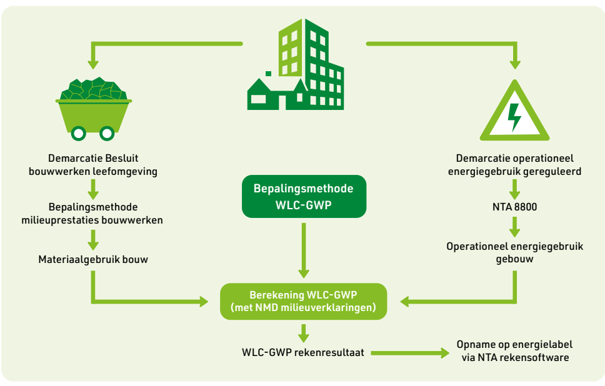
The calculation can be carried out using a calculation tool validated by Stichting NMD. In this calculation tool, the WLC-GWP is calculated using environmental declarations (for both construction products and energy carriers) drawn up in accordance with the Environmental Performance of Buildings Determination Method. For operational energy use, the energy flows based on the Energy Performance calculation are linked to the NMD environmental declarations of the relevant energy carrier(s).
Calculating the WLC-GWP therefore requires interaction between the EP advisor and the person carrying out the WLC-GWP calculation, both for sharing operational energy use data and for the WLC-GWP calculation result needed for the energy label.
Detailed information on how this information exchange will take place is still being worked out. Clear instructions on this will be particularly important for parties such as calculation tool providers, EP advisors, and MPG preparers.
Who does the calculation apply to?
The WLC-GWP Determination Method applies to new buildings. It does not apply to civil engineering works (infrastructure).
From 2028, a calculation obligation applies to new buildings with a floor area larger than 1,000 m². From 2030, the calculation obligation applies to all new buildings, and limit values will also apply to all new buildings.
What is the role of Stichting NMD?
Stichting NMD manages the existing Environmental Performance system, including the Environmental Performance of Buildings Determination Method, the associated databases, and validated calculation tools. With the introduction of the WLC-GWP, this role expands to include management of the WLC-GWP Determination Method.
EPBD IV
The European EPBD IV directive largely determines the obligations surrounding the WLC-GWP. Further implementation and elaboration of these obligations are still under development and subject to decision-making by the Ministry of BZK.
Related news


