Conversation with calculation tool owners:
Aceve

Calculation tools form an important link between environmental data and their application in the practice of sustainable construction. Tool owners develop and manage these calculation tools and ensure that they align with applicable methodologies, regulations and user needs. In this series, we highlight the role of tool owners within the sustainability framework and explore the development of calculation tools, the collaboration with Stichting NMD, and current developments in practice.
In May we spoke with Roderik von Maltzahn of Aceve.

With a background in both construction engineering and software development, Roderik von Maltzahn has been working for many years on the digitalisation of the construction sector. In his role as Product Owner at Aceve, he focuses on developing user-friendly software solutions that provide professionals with insight into the environmental impact of buildings and design choices.
What can you tell us about your calculation tool?
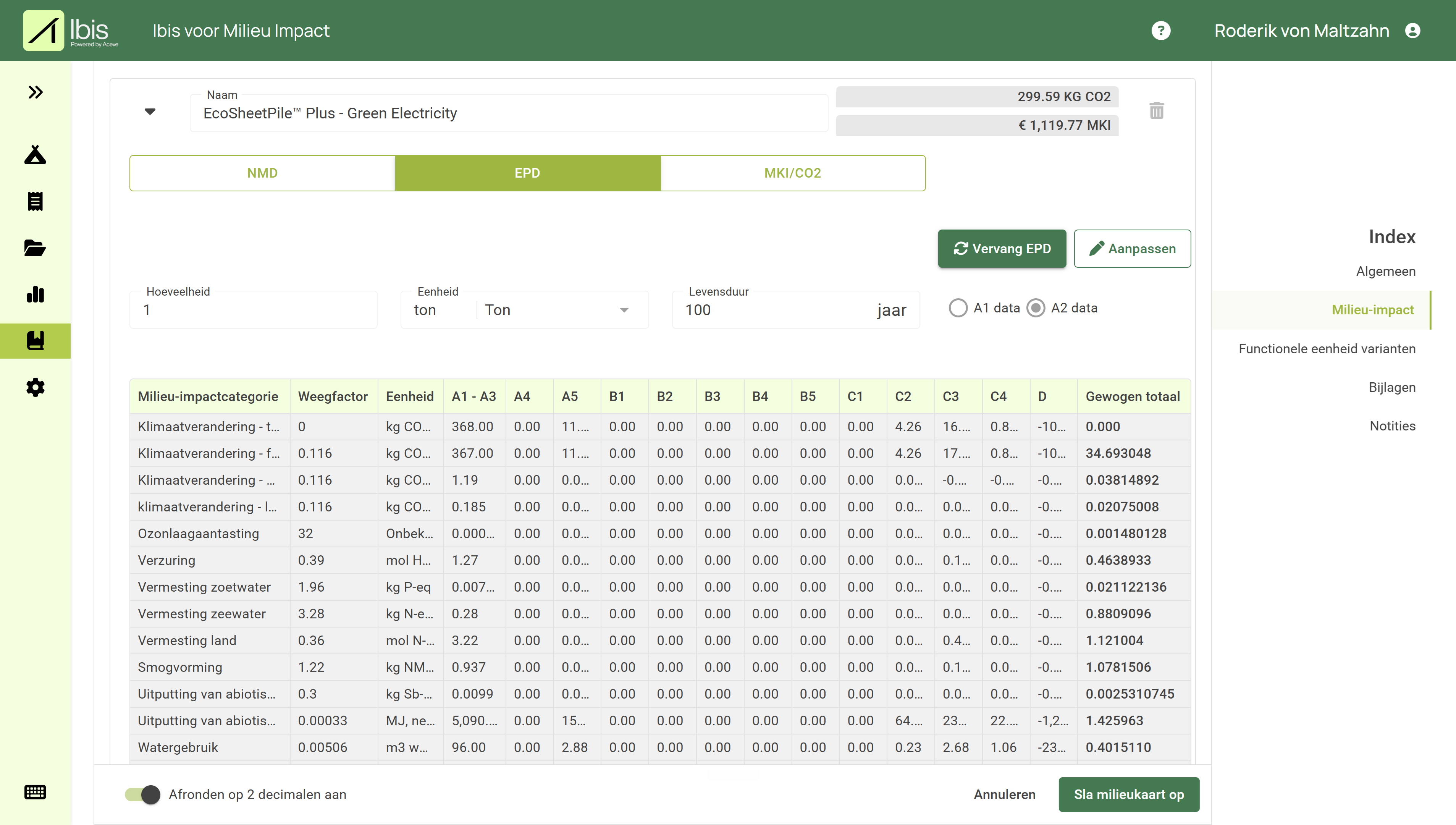
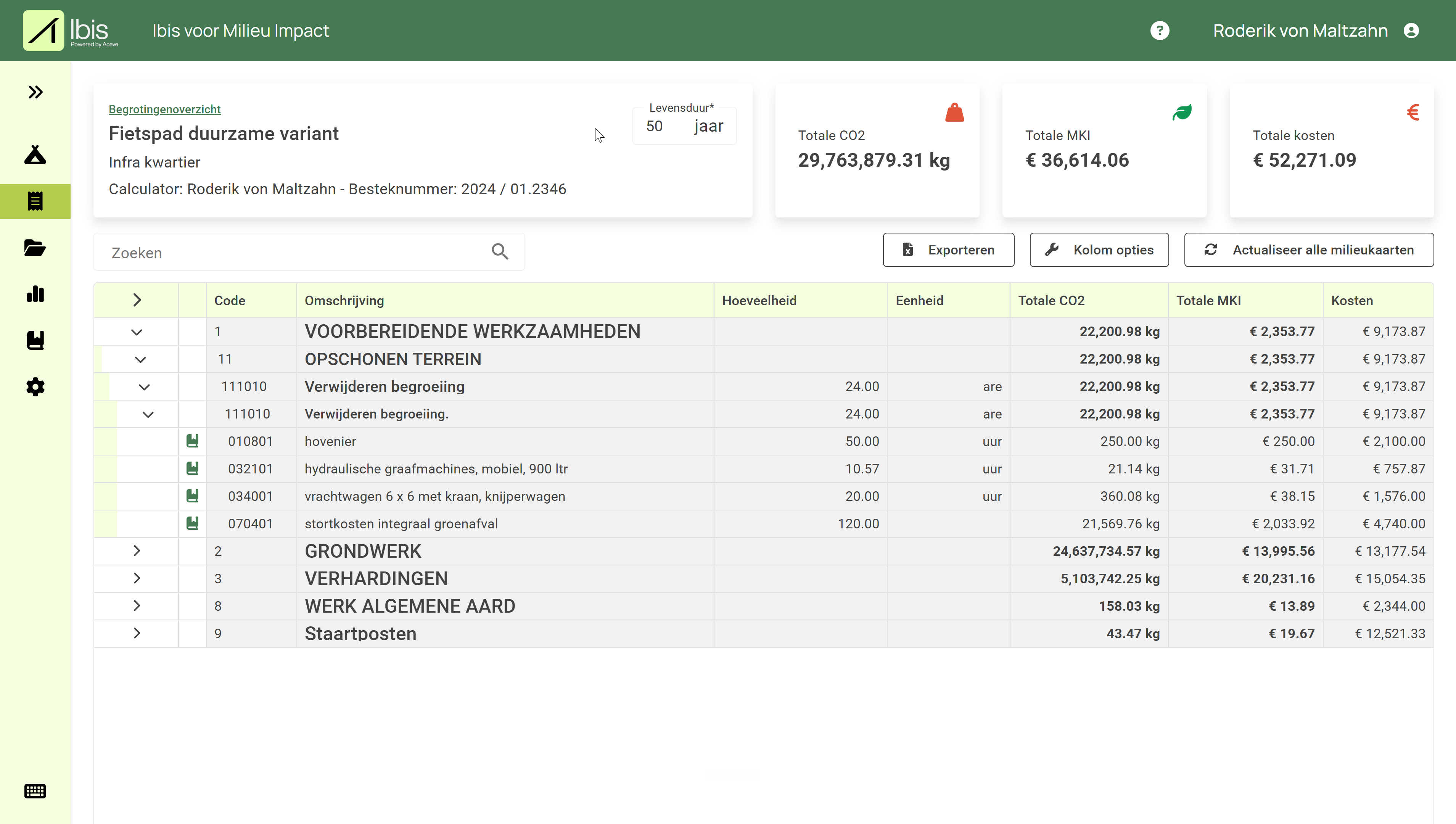
“IBIS stands for Integrated Building Information System. We provide cost estimation software for both the civil engineering and infrastructure sector (GWW) and the building and construction sector (B&U). When customers asked for a tool that would integrate seamlessly with our estimating software to perform environmental performance calculations, we took the step towards Stichting NMD. For that, we needed environmental data from the Dutch Environmental Database, which is how we became a validated calculation tool owner.
The advantage of Ibis is that, alongside environmental impact, it also provides direct insight into financial impact. This makes it easier for users to make sustainable choices during the design and construction process.”
Can you tell us about any current developments or new innovations?
“Certainly. We have developed a new feature that allows EPDs and environmental declarations to be imported into our platform automatically. This means users no longer have to enter the data manually into their own environment and can use the data directly for environmental performance calculations. In addition, automation significantly reduces the likelihood of errors. It is one of the innovations that will considerably accelerate the process, and we are very proud of it.”
You became a validated calculation tool owner with Stichting NMD over the past year. What do you experience as positive in the collaboration, and where do you see opportunities for improvement?
“We have short lines of communication, which works well. Whenever something needs to be discussed, responses are quick. Stichting NMD is also open to suggestions; recently, input was requested from the calculation tool owners, and those suggestions were subsequently discussed and acted upon.
In the past, there were some challenges in the communication surrounding the biannual validation process. With the introduction of a roadmap that includes all relevant developments and activities, this has improved significantly. I see that as a very positive development.
In addition, we are involved in developments in collaboration with digiGO. It is valuable that these digiDeals help improve the data landscape. At the same time, I see opportunities for Stichting NMD to further inform certain stakeholders, such as smaller clients, about the possibilities and benefits of sustainability.”
What do you see as the added value of one shared database for environmental performance calculations?
“The main advantage is comparability. Environmental data used in LCAs is often based on background databases such as Ecoinvent. Many EPDs are calculated using different background databases from across Europe, which makes the resulting environmental data less comparable and therefore less useful. The value of a single shared database lies in the fact that the data can be compared more consistently, making it far more valuable.
The same applies to the system boundaries used in calculations. Some clients only calculate environmental impact during the production phase, while others include the entire life cycle. These differences make comparison difficult, even though comparison is exactly what is needed to make informed decisions.”
What are you most proud of in the collaboration with Stichting NMD?
“We contribute to several digiDeals, in particular the digiDeal Availability and accessibility at ETIM decomposition level. It is rewarding to work towards a standardised coding system that enables environmental data to be linked more effectively and supports further automation. I see that as a valuable collaboration.”
What would you most like users of your calculation tool to know?
“With our calculation tool, users can enrich cost estimates with environmental impact data in a reusable way, and the process is becoming increasingly efficient. Since recently, Ibis has become part of Aceve, which means we have grown into a European organisation. From that position, we aim to provide the North-West European market with calculation software for environmental performance assessments.”
Want to learn more about Aceve and their calculation tool?
Visit their website:
Aceve - Ibis voor Milieu Impact
Read more about:
Read more:


