Which Assessment Method applies when to existing buildings?
For interventions in existing buildings—such as renovation, transformation, or maintenance—the environmental impact of material use can be calculated. Various Assessment Methods have been developed within the environmental performance system for this purpose.
On this page, you can read which method suits the purpose of your calculation and the scale of your project.
The distinction between the Assessment Method for ECB Renovation & Transformation (R&T) and the Assessment Method for Environmental Performance Maintenance (MPO) is based on the purpose and scale of the calculation.
Assessment Method for ECB Renovation & Transformation (R&T) |
|
Purpose Result Application |
Assessment Method MPO |
|
Purpose Result Application |
Comparing plan variants
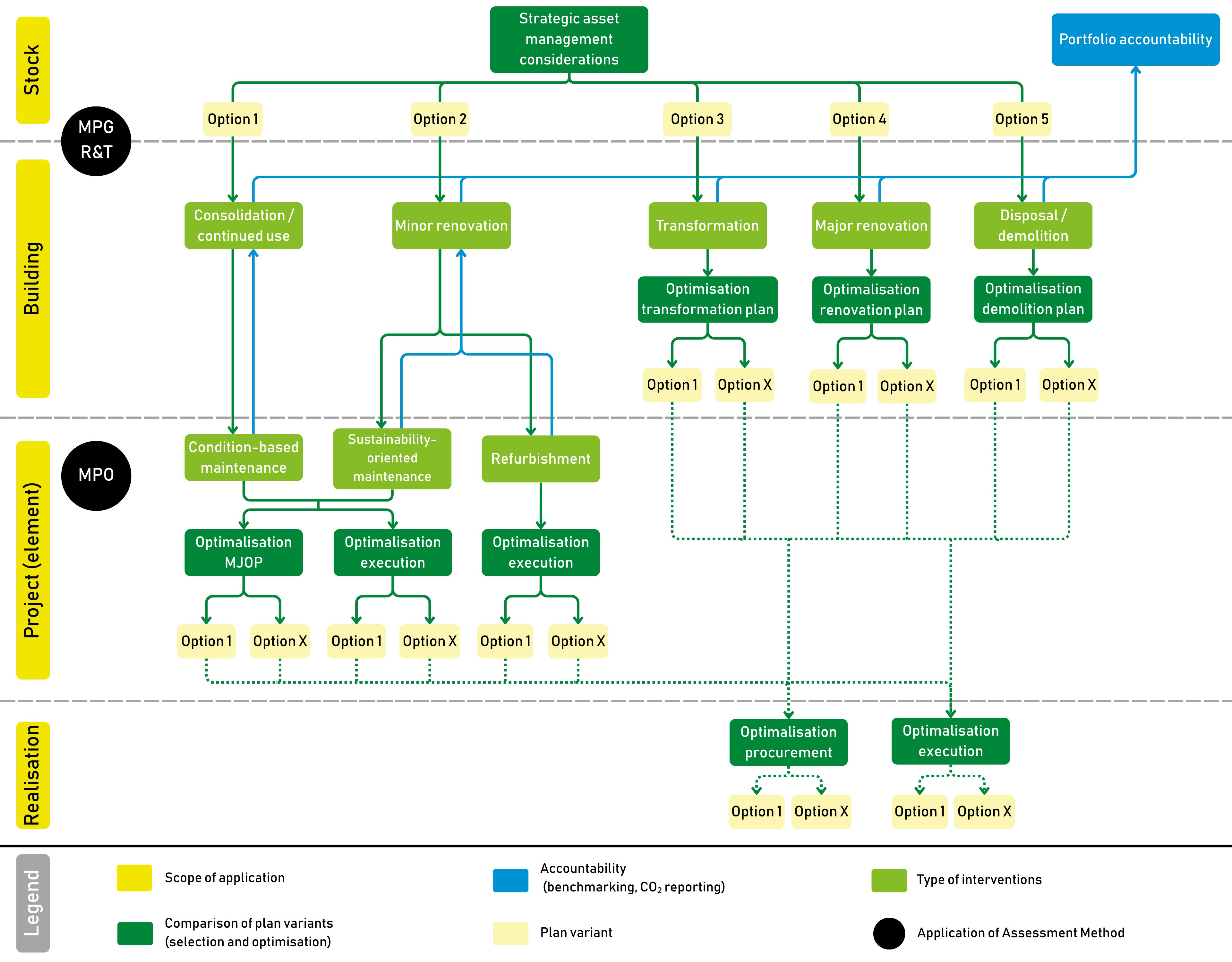
When comparing project or plan variants, all intervention options considered must be calculated using the same assessment method, appropriate to the scale and purpose of the evaluation. Only then is a meaningful comparison possible. The diagram below shows which method is applied in each situation.
Practical examples
To demonstrate how the methods can be applied in practice, various practical examples have been developed. These examples illustrate different real-world situations and help users determine which method best suits their project.
Below, various use cases are described for each method. These are practical examples centred around specific questions, with an explanation of which Assessment Method for existing buildings can be applied in each situation. The methods can be used to compare and optimise scenarios or plans, in procurement processes, and for monitoring purposes.
This collection of practical examples will be further expanded in the coming period. Do you have a question or a practical case you would like to see included? You can submit it via the contact form.
Please note: the examples are intended to illustrate the scope of application of the methods and do not constitute user instructions. Detailed guidance will be added at a later stage.
Application Assessment Method Environmental Performance Renovation & Transformation
The Assessment Method Environmental Performance Renovation & Transformation includes two methodological variants, which differ in the scope of product flows included in the calculation. For both variants, an MPG of the building is calculated. The two variants are:
Core variant MPG R&T
In the core variant, the scope is limited to the product flow of added construction products. The existing situation (including products to be removed during the intervention and products to be retained) is not taken into account. As a result, a full inventory of the existing building is not required. This variant is particularly suitable for situations where the existing building has not yet been fully assessed.
Extended, optional variant MPG R&T
In the extended variant, not only the added construction products are included, but also the products to be removed and retained. This results in a more comprehensive view of the total material-related environmental impact of the intervention. This variant is particularly suitable when the existing situation has been well documented and a more detailed assessment is required, for example for accountability or to steer circularity objectives.
Situation
An existing building is being renovated or transformed. In most cases, the load-bearing structure is retained, while other building components such as façades, installations and interior finishes are modified or replaced.
During the design phase, multiple variants of the renovation approach are often developed. These variants may differ, for example, in:
- material choices for façades or roofs
- type of installation system
- level of insulation or façade modification
- choices in interior finishing
The issue arises when multiple design variants are explored within a single renovation project and their material-related environmental impact needs to be compared.
This situation typically occurs in design studies for renovation projects, in the development of different renovation concepts, and in the optimisation of material choices within a project.
Application of the Assessment Method
For all variants considered in this situation, the Assessment Method Environmental Performance Renovation & Transformation is applied. The calculation focuses on the environmental impact of newly added construction products in the renovation design. Retained and removed construction products may be excluded from the calculation.
The result of the calculations is an MPGR&T score.
Explanation
The existing situation is often difficult to fully assess. Information on retained and removed construction products and their quantities is frequently limited. By focusing the calculation on newly added products, design variants can be compared relatively easily without requiring a complete inventory of the existing building.
If sufficient information on the existing construction products is available, the optional, more comprehensive MPG R&T calculation can also be performed, including the environmental impact of all product flows (added, retained and removed).
Interpretation
Comparing the MPG R&T scores provides insight into the environmental impact of different design choices within the same renovation project. The results help design teams to optimise material choices, system solutions and renovation concepts.
Situation
An owner or developer is faced with a decision on what to do with an existing building that is still in reasonable technical condition but functionally or energetically outdated.
The situation concerns a building-level comparison between two development strategies:
- a scenario in which the existing building is completely demolished and replaced by a new building
- a scenario in which the existing building is transformed or renovated, with parts of the structure retained
This type of assessment typically occurs during the feasibility phase of a project, in procurement procedures, or as part of strategic decision-making by building owners.
Application of the Assessment Method
- For calculating the environmental performance of scenario 1, the Assessment Method for Environmental Performance of Construction Works is applied, as this concerns a fully new building. Demolition is not included. The result is an MPG score.
- For scenario 2, the Assessment Method Environmental Performance Renovation & Transformation is applied, focusing only on the added construction products (the core calculation of the method). The result is an MPGR&T score.
In practice, the renovation scenario is often developed first, as the scope is highly situation-specific. For new construction, reference buildings or benchmark values are frequently used for comparison.
Interpretation and explanation
The existing situation is often difficult to fully assess; at the time of calculation, information on construction products to be removed or retained is often incomplete. In addition, in major renovation projects, the contribution of removed and retained products to the total environmental impact is relatively limited. Therefore, the focus in this situation is on the added construction products.
The difference between the results of the calculations (MPG scores) for both scenarios shows how much material-related environmental impact can be avoided by retaining existing building elements. However, because the calculation focuses only on added products, it does not represent the full environmental impact of the interventions, as removed and retained products are excluded.
Situation
A building owner, such as a housing association or real estate manager, is faced with a strategic decision regarding the future of an existing building or a portfolio of buildings. This assessment is part of strategic asset management, where decisions on long-term interventions are made based on various criteria.
Possible strategies include:
- continued use or consolidation (retention with limited maintenance)
- renovation (and/or sustainability improvements)
- transformation to a different function
- demolition and new construction
The issue arises when these strategies need to be compared based on their material-related environmental impact as part of broader decision-making. At this stage, choices regarding the level of intervention, intended life extension and desired (energy-related) performance improvements are often still open.
Application of the Assessment Method
In this situation, the Assessment Method Environmental Performance Renovation & Transformation is applied using the extended variant. In this variant, all three product flows are included:
- added construction products
- removed construction products
- retained construction products
The result of the calculation is an MPGR&Toptional score per strategy.
Different strategies can vary significantly in the extent of demolition, retention and addition of building elements. It is therefore essential in this context to include all product flows in the calculation. This provides a complete and comparable view of the material-related environmental impact of the different strategies.
Interpretation
The results provide insight into the total material-related environmental impact of different strategic scenarios and support decision-making within strategic asset management. The comparison makes it clear:
- what the impact is of different levels of intervention (including life extension, energy performance and functional quality)
- how much material-related impact is associated with demolition and replacement versus retention
- which strategy best aligns with sustainability objectives
Situation
A contracting authority, municipality or building owner aims to steer the environmental impact of renovation or transformation projects. This may be done through policy objectives or requirements in procurement procedures. Examples include:
- a maximum environmental impact for renovation projects
- a target for material-related CO₂ reduction
- an ambition to apply circular materials
- a requirement to make the material impact of renovations transparent
The level of detail of the renovation scope can vary significantly. In some cases, there is an open design brief with only functional requirements defined. This allows substantial room for integral optimisation in terms of material impact, design quality, functionality or aesthetics. Solutions may range from minor interventions to major renovations.
In other cases, the renovation scope is largely predefined, with a design or intervention package already in place. In such situations, the comparison focuses more on material choices and product specifications.
Application of the Assessment Method
When defining requirements or objectives for a renovation project, the Assessment Method Environmental Performance Renovation & Transformation is applied. Depending on the project phase and level of detail, two approaches can be used:
1. Core calculation MPG R&T
(only newly added construction products are included).
This approach is applied when:
- the existing situation has not been fully assessed and information on existing construction products is not available
- the design brief is still open and different solution directions need to be compared. A key characteristic is that there may be significant variation between solutions in terms of demolition, retention and type of intervention. By focusing only on added construction products, strategic calculation choices can be avoided.
2. Extended, optional calculation MPGR&Toptional
(added, retained and removed construction products are included)
This approach is applied when:
- the existing situation is well documented
- the renovation scope has been clearly defined in advance, including design or intervention measures
- insight into the full material-related environmental impact of the intervention is required
By including all product flows, this approach enables better steering on circularity.
Interpretation
The results of the calculations can be used, for example, to define project-specific benchmarks, compare renovation solutions, or establish policy objectives for material use and circularity.
Toepassing Bepalingsmethode Milieuprestatie Onderhoud
The Assessment Method Environmental Performance Maintenance includes two approaches for determining the environmental performance of an intervention at building element level, depending on whether it concerns a one-off intervention or a series of planned interventions over time.
In both approaches, the environmental performance calculation includes both added and removed construction products. The result in both cases is an ECI at project level:
Simplified (forfaitaire) approach
This approach is applied when there is a specific intervention moment. This may involve a single intervention, or multiple interventions affecting one or more building elements. Examples include non-planned (corrective) maintenance, combined maintenance interventions at a single moment, and project-based interventions (such as refurbishments).
The key principle is that interventions carried out after the initial intervention moment are not explicitly included. As a result, product replacements in the simplified approach always consist of the same products as the initial product.
Specific approach
This approach is applied when all interventions are explicitly scheduled over time, and therefore do not concern a one-off intervention. This is typically the case in a multi-year maintenance plan (MJOP), where all maintenance interventions (and in some cases refurbishment interventions) are mapped over a defined assessment period.
In this case, there is usually an initial intervention followed by planned subsequent interventions. Because maintenance is scheduled over time, it is possible to optimise maintenance cycles and vary replacement cycles.
Situation
A building owner, such as a housing association or real estate manager, carries out a one-off maintenance project, for example to address deferred maintenance or to restore a building to the desired quality level. The owner wants to determine which scenario of activities results in the lowest environmental impact. Activities within a one-off maintenance project may include:
- replacement of roofing
- maintenance, replacement or repair of window frames
- painting of façades
- replacement of glazing
- maintenance or replacement of installations
A large-scale maintenance project may apply to a single building, but is often carried out on a larger scale, such as across a series of similar buildings, an entire residential area or multiple school buildings. The project scope is defined in advance, including which and how many building elements are involved, which activities will be carried out, and the desired quality level after completion.
Application of the Assessment Method
In this situation, the simplified (forfaitaire) approach within the Assessment Method Environmental Performance Maintenance (MPO) is applied. The calculation focuses on the activities carried out within the maintenance project. The result is an ECI score at project level.
Explanation
Unlike planned maintenance, there is no fully developed multi-year maintenance plan (MJOP) for future maintenance cycles in this situation. The calculation therefore focuses on the impact of the interventions carried out within the project. Both the environmental impact of newly added products and the impact of construction products removed from the building are included.
Interpretation
The results make it possible to compare and optimise different scenarios, each representing different execution variants within the maintenance project. They also provide insight into the balance between replacement and the retention and maintenance of existing building elements. In some cases, it may become clear that maintaining or making limited adjustments to existing elements results in a lower environmental impact than full replacement.
Situation
A building owner, such as a housing association or real estate manager, performs maintenance based on a multi-year maintenance plan (MJOP). The objective of these activities is to maintain the building in good technical condition and to ensure the service life of existing building elements. The MJOP includes, over a predefined time period, specific interventions on building components that require maintenance and have a defined replacement cycle.
An MJOP typically includes activities such as:
- painting of window frames or façades
- replacement of roofing
- replacement of installations at the end of their technical service life
- maintenance of installation systems
Foundations and load-bearing structures are generally not part of an MJOP.
The purpose of carrying out an environmental performance calculation in this context is to gain insight into the environmental impact of planned maintenance and how material choices or maintenance strategies (retention and maintenance versus repair or replacement) influence this impact. This situation applies when optimisation of MJOP strategies is required, when housing associations want to analyse their maintenance programmes, or when insight is needed into the environmental impact of planned or executed maintenance.
Application of the Assessment Method
In this situation, the specific approach of the Assessment Method Environmental Performance Maintenance (MPO) is applied. The ECI values of the maintenance activities within the MJOP are aggregated into a single ECI at project level or for a maintenance programme. Both the environmental impact of newly added products and the impact of construction products removed during interventions are included.
Interpretation
The results provide insight into the environmental impact of different maintenance strategies and material choices. For example, it can show whether retaining and maintaining existing elements results in a lower environmental impact than replacing a construction product.
Situation
A building owner wants to gain insight into the environmental impact of maintenance activities carried out annually on a building or a portfolio of buildings. This may be done, for example, in the context of:
- ESG reporting by housing associations
- sustainability reporting by real estate organisations
- internal monitoring of maintenance programmes
- analysis of the environmental impact of completed activities
Application of the Assessment Method
In this situation, the specific approach of the Assessment Method Environmental Performance Maintenance (MPO) is applied. The maintenance activities carried out within the assessment period (for example, one year) are known or are based on a maintenance plan, maintenance programme or completed works. The result of the calculation is an ECI score at project level.
The maintenance activities are modelled at product or activity level, such as the replacement of installations, roofing or glazing, or maintenance of façades or installation systems. For each activity, both the environmental impact of newly added products and the impact of products removed during the activity are included.
Interpretation
The results provide insight into the total annual environmental impact of maintenance activities and can be used for reporting or monitoring purposes. In addition, the results support the evaluation of maintenance strategies and can serve as input for identifying key impact areas within maintenance activities.


Questions or input
Do you have questions or a new usage scenario we could add to the list? Let us know via the form below.
Would you like to stay informed about further developments regarding the Assessment Methods for existing buildings? Sign up for our newsletter.
Back to the environmental performance overview
This page is part of the overview on the application of environmental performance in construction. On the overview page, you can read how environmental performance is applied in Civil and Utility Construction (B&U) and in Civil Engineering and Infrastructure Works (GWW).
Related news items


