Conversation with calculation tool owners:
Alba Concepts

Calculation tools form an important link between environmental data and their application in the practice of sustainable construction. Tool owners develop and manage these calculation tools and ensure that they align with applicable methodologies, regulations and user needs. In this series, we highlight the role of tool owners within the sustainability framework and explore the development of calculation tools, the collaboration with Stichting NMD, and current developments in practice.
In April, we spoke with Jim Teunizen and Mike van Vliet of Alba Concepts.

Jim is co-founder of Alba Concepts and founder of BCI Gebouw. As a driving force behind the circular construction economy, he works on the development of methodologies, data-driven steering and practical solutions related to circularity, environmental impact, demountability and residual value of buildings.
Mike is Product Manager for BCI Gebouw. From within Alba Concepts, he focuses on circularity in the construction sector. In his role, he works on the further development of BCI Gebouw as a calculation tool, circularity-related issues, and translating complex sustainability data into practical insights for the market.
Who are you and what is your calculation tool?
Mike: “We are BCI Gebouw, a calculation tool for circularity and environmental impact in the construction sector. Around five years ago, we started as a tool for the sector to calculate the circular performance of buildings. For this, we use our own developed assessment methodologies, including methods for material use, demountability and the Building Circularity Index (BCI).
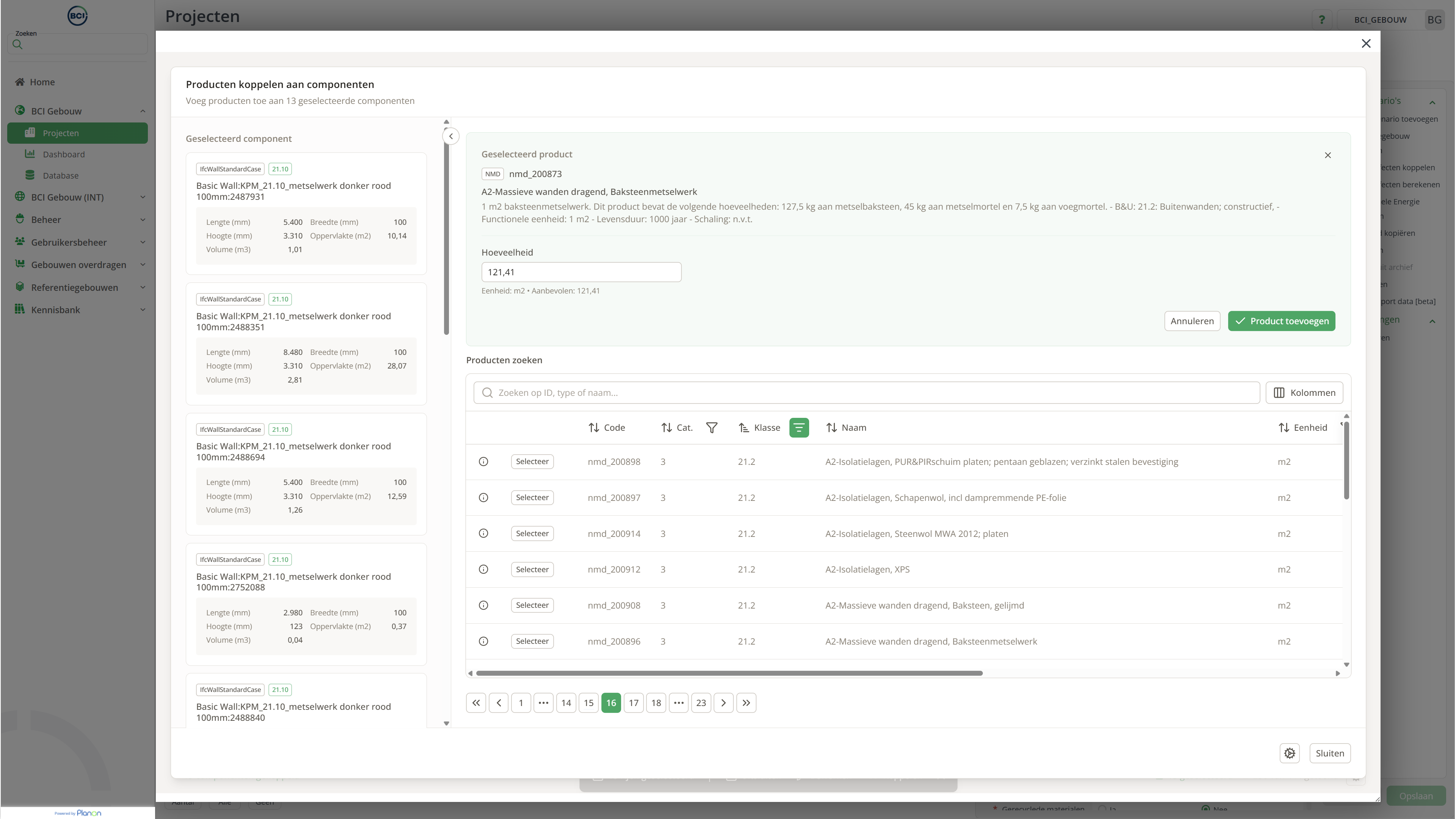
We originally developed BCI almost ten years ago. What started as a small-scale operation with one or two calculations per month has grown into a one-stop shop for everything related to circularity and environmental impact. In collaboration with our technology partner Planon, we now offer our platform as a calculation tool in which all aspects can be calculated in an integrated way. We achieve this by intelligently linking data sources together. As a result, users can work with a single calculation for all key performance indicators in the market related to circularity and environmental impact.
In addition to circularity, demand later emerged for calculating the environmental impact of materials. That is why, in 2023, we decided to become a validated calculation tool for Stichting NMD.”
Jim: “BCI Gebouw is a subsidiary of the circularity consultancy Alba Concepts. This means we have access to a large team of consultants with extensive expertise in environmental performance calculations, circularity and sustainability within the built environment. It enables us to efficiently connect practical knowledge from projects with the further development of our platform and calculation methods.
We notice that this combination of substantive expertise and software knowledge is highly valued by our users. Our helpdesk not only supports users with questions about the system itself, but also provides substantive guidance when needed. That is what distinguishes us as a calculation tool: we are a software company with extensive expertise and a strong understanding of the market.”
How do you make such an integrated calculation possible?
Mike: “For environmental data used in Dutch calculations, we work together with the Dutch Environmental Database. We then enrich this data, both manually and through AI integrations, by adding circularity data from other sources. In this way, a single action enables users to perform a calculation using data from multiple sources to determine all environmental and circularity indicators.
At the moment, we are expanding our services by offering access to additional EPD databases, such as those connected to ECO Platform. Naturally, this remains separate from Dutch MPG calculations.”
How does the calculation process work in practice?
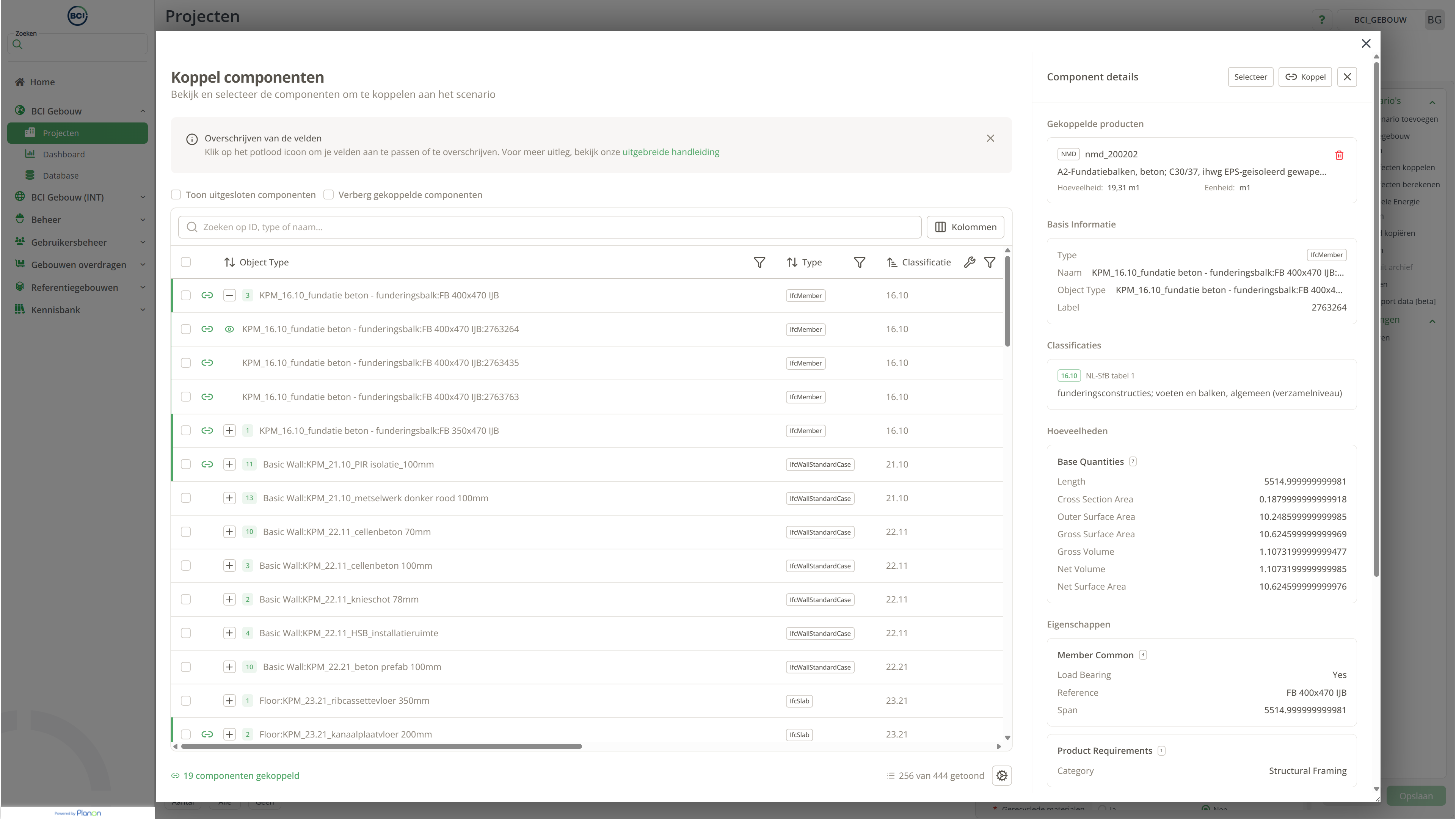
Mike: “As a calculation tool, we initially started quite simply by manually selecting products from the database and entering quantity take-offs. Today, the process works differently. Last December, we launched a BIM importer. This means users can now upload BIM models as .IFC files, after which all relevant data becomes available to prepare a calculation. We are still actively developing this functionality based on user feedback, which has proven very valuable.
In addition, we are in the final stage of expanding the importer to support Excel file imports. This functionality will soon be launched alongside the option to upload BIM models.
Users can also start from reference calculations. We have a large number of these available, for example for residential buildings and offices. We initially used the RVO reference buildings as a foundation. From there, we identified several opportunities and challenges, which we addressed together with our consultants to create complete and up-to-date calculations. This makes it possible to start from a consistent guideline using these reference calculations. We are still working intensively on keeping these calculations current and further improving them.”
Are there any other developments or innovations you would like to highlight?
Jim: “Certainly. As mentioned earlier, BCI Gebouw collaborates with Planon, a market leader in Integrated Workplace Management Systems (IWMS). We plan to use data from Planon users to gain more insight into the MPO (Environmental Performance Maintenance) at both building and portfolio level. This is something we will continue to further develop over the next two quarters.
This is highly relevant, because around 90% of MPG calculations are currently carried out for new construction, while the largest environmental impact actually lies within the existing building stock. All maintenance and renovation activities combined have a far greater environmental impact than developments in new construction. This is one of the key areas we intend to focus on in the coming years.
There is also another important development: this year, we will start integrating financial data into our platform. This will make it possible, for example, to express CO₂ impact per euro invested as a new type of performance indicator. To achieve this, we will connect building and maintenance costs with financial residual value and other circular financial incentives. Through this integration, BCI Gebouw will be able to generate the financial business case as well.
We are convinced that this development represents the next step towards a circular construction economy.”
What do you experience as positive in the collaboration with Stichting NMD, and where do you see opportunities for improvement?
Mike: “I think the collaboration with Stichting NMD is currently working very well. As a relatively new party, we have now been involved in the system for almost three years — a period marked by many new tool owners and developments. We recognized the need to professionalise the collaboration and have actively contributed to that by maintaining open dialogue and identifying bottlenecks at an early stage.
In this way, we have built a strong collaborative relationship together. We also identified several areas for improvement within the validation process and worked on those jointly. Recently, we were validated for the MEPG, and we are very satisfied with how that validation process went. We were kept well informed, had constructive discussions, and were able to identify several ambiguities and points requiring clarification, which we then resolved together.
As a result, the entire process progressed smoothly, and I am very pleased about that. I sincerely hope we can continue this way of working together.”
Jim: “I also notice that Stichting NMD now has a much stronger position in the market. In the past, there was more criticism directed at Stichting NMD, which in my view was not always justified. During that period, we tried as much as possible to support Stichting NMD in the dialogue with other market parties. I also did not consider the way criticism was sometimes expressed to be constructive, because it was not solution-oriented. That criticism has decreased significantly, which I see as very positive and beneficial for the system as a whole.
I also believe we must continue to maintain this constructive attitude together, because it naturally comes from both sides. Not only Stichting NMD, but also the tool owners, need to uphold that level of professionalism.”
Mike: “One area for improvement I still see is that Stichting NMD, in my opinion, sometimes takes on too many developments simultaneously. This can make prioritisation difficult and affects overall focus. Of course, that remains a challenge for both Stichting NMD and the tool owners. I see an opportunity there to continue communicating closely together.”
What do you see as the added value of one shared database for environmental performance calculations?
Mike: “That added value is truly enormous. At BCI Gebouw, we also want to offer international databases for our international clients, and through those we have access to a very large number of EPDs. However, there is a significant variation in the quality of that data, which makes it difficult to use reliably for calculations.
Preparing an LCA is genuinely complex work. When you compare the data quality within the NMD with the 35,000 international EPDs available in our tool, you notice that it is considerably more difficult to assess the quality of those international EPDs.
That inconsistency in data quality does not apply in the Netherlands. The advantage here is that everything is certified and validated according to the same principles. A great deal is happening in Europe in terms of developments, and we are following those closely, but it will still take considerable time before this becomes fully harmonised. With the NMD, the Netherlands is truly leading the way in this area.”
Which developments in regulations and policy are impacting your calculation tool?
Mike: “First of all, there are the developments of new assessment methods such as the MPO, MPG R&T and the WLC-GWP. In addition to Stichting NMD, there are also other assessment methods and frameworks that generate new insights in the areas of circularity and environmental impact. Since, as a tool owner, we aim to be a one-stop shop for all assessment methods, tools and indicators, this means we continuously have to adapt to these developments. That also makes the landscape quite complex and demanding.
We are still seeing divergence in assessment methods due to evolving insights. Existing methods are becoming more refined, but there remains a strong need for one common framework and one shared database. Fortunately, there are also digiDeals focusing on the use of environmental data, and ongoing discussions between tool owners and Stichting NMD, which is very positive.”
What are you most proud of in the collaboration with Stichting NMD?
Jim: “I am proud that together we have taken important steps towards a more robust and professional validation system. The professionalisation of the validation protocol was urgently needed, and thanks to the flexible collaboration we have genuinely made progress in this area. At the same time, I still see many opportunities for further development, particularly in the automation of the validation process. In the future, an increasing number of validations will be required, making further scaling and efficiency essential.”
What would you particularly like users of your calculation tool to know?
Jim: “BCI Gebouw is not only focused on MPG projects for new construction; we also have expertise and experience in applying assessment methods within the existing building stock, such as for renovation and transformation projects and within MJOPs, in collaboration with our technology partner Planon. If users are interested in this, they are welcome to contact us about the solutions we offer.”
Mike: “Since April, users have been able to carry out MEPG calculations within BCI Gebouw. In addition to validating the calculation rules, we have also adapted our user interface to make adding energy data to calculations much easier. Users no longer need to search for the correct environmental declarations in the NMD; those selections have been predefined, making the process less error-prone. In addition, both MPG and MEPG are now carried out within a single calculation.
More improvements are coming in the near future, both in terms of usability and new assessment methods. So there is plenty to look forward to.”
Want to learn more about BCI Gebouw and their calculation tool?
Visit their website: