Conversation with calculation tool owners:
Madaster

Calculation tools form a crucial link between environmental data and its practical application in sustainable construction. Tool owners develop and manage these calculation tools and ensure that they align with current methodologies, regulations and user needs. In this series, we highlight the role of tool owners within the sustainability framework and reflect on the development of calculation tools, the collaboration with Stichting NMD, and current developments in practice.
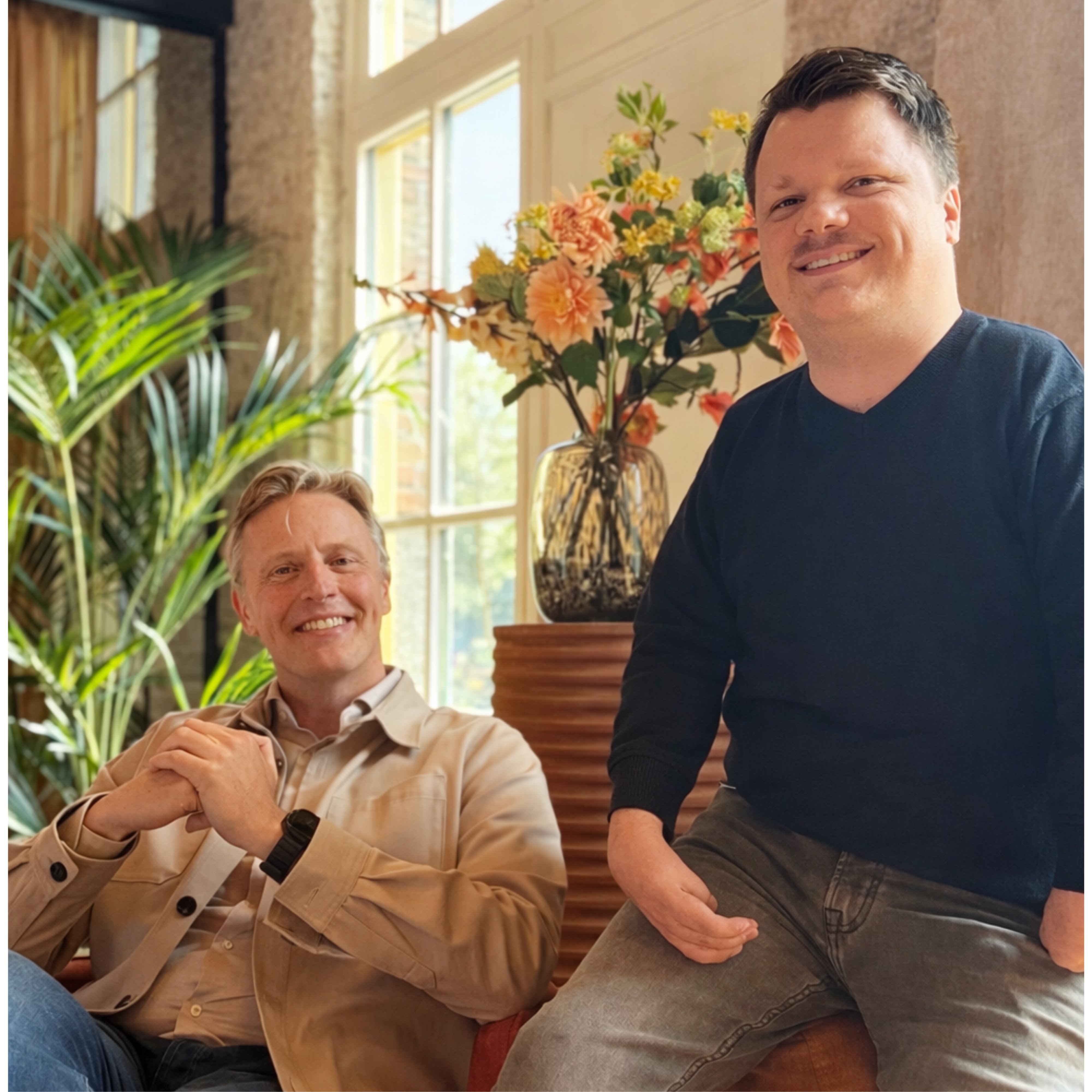
This month we speak with Martijn Oostenrijk and Bram Orsel of Madaster.
Who are you and what is your role?
Bram: I’m Bram Orsel. I’ve been working at Madaster for over a year and a half as a sustainability consultant. My focus is mainly on the implementation side of our platform, including its role as a calculation tool for Stichting NMD. I also work with clients to help them make the best use of our platform and maximize its value for their organization.
Before joining Madaster, I worked for five years at VolkerWessels, specifically at Aveco de Bondt. There, I already had similar assignments for our end clients, often working with Madaster. Now, I’m essentially doing the same thing, but from within Madaster.
Martijn: My name is Martijn Oostenrijk. I’m a co-founder of Madaster and also serve as its CEO. We established Madaster in 2017, and I’ve been involved from day one.
My background is in business administration and business economics, with experience in the financial sector. My journey with Madaster began around mid-2016.
What can you tell us about your calculation tool?
Martijn: Madaster was founded in 2017. It originated from the vision of Thomas Rau and his book Material Matters. Madaster aims to achieve a waste-free construction sector by giving materials in the built environment a digital identity—that is our mission. Madaster also stands for ‘the cadastre for materials.’
Initially, this was more of a registry function. Over the years, we’ve proudly seen that we are strongly associated with this registry function, and especially with the materials passport within the industry. But I’m happy to say we’ve grown beyond that. In addition to being a registry and a materials passport facility, we are also a calculation tool. We serve not only Stichting NMD but also a range of certification schemes. We’ll come back to that later.
Furthermore, we operate in seven countries. In that sense, we might be different from other tools in the Netherlands. We are active in Germany, Austria, Switzerland, Belgium, the United Kingdom, and Norway. In these countries, we have 400 clients from the construction sector and around 2,000 users of our software.
How do the different requirements and procedures in those countries affect your calculation tool?
Martijn: It affects us enormously. What we must do—and this is inherent to being a calculation tool—is meet those local preferences. In the Netherlands, our platform must incorporate the measurement methodologies (MKI, MPG) from Stichting NMD, as well as certification schemes such as BREEAM. Across borders, each country has its own preferences. In Germany, for example, there is a measurement methodology focused on circularity and delivering a materials passport. Therefore, we have integrated various schemes across these countries into our platform. Depending on where the user is located, they can select the different schemes to measure, manage, and demonstrate the extent to which their performance meets the required standards.
And how does the Netherlands differ from the other countries where you are active with your calculation tool?
Martijn: My general response is that all these local preferences are very similar and overlap by about 80-90%. The biggest difference is that, over the years, a lot has been created in the Netherlands. We are leading in terms of how and what to measure. You see that surrounding countries also look to the Netherlands as an example in this regard. But we are also quite easily distracted.
What kind of distractions are those, for example?
Martijn: If you look at the Netherlands over the past five years, there have been initiatives such as CB23, Het Nieuwe Normaal, Stichting NMD with its system, and the shift from circular construction to biobased. All of these have tremendous value—let that be clear—but they also create a lot of noise within the construction chain. Where should we focus now? For example, the conflict between energy and materials is now being addressed with the MEPG. But quite a lot is coming at the sector, and I call that a bit of a ‘distraction’—though maybe that’s a slightly too negative word.
How does the calculation process work exactly?
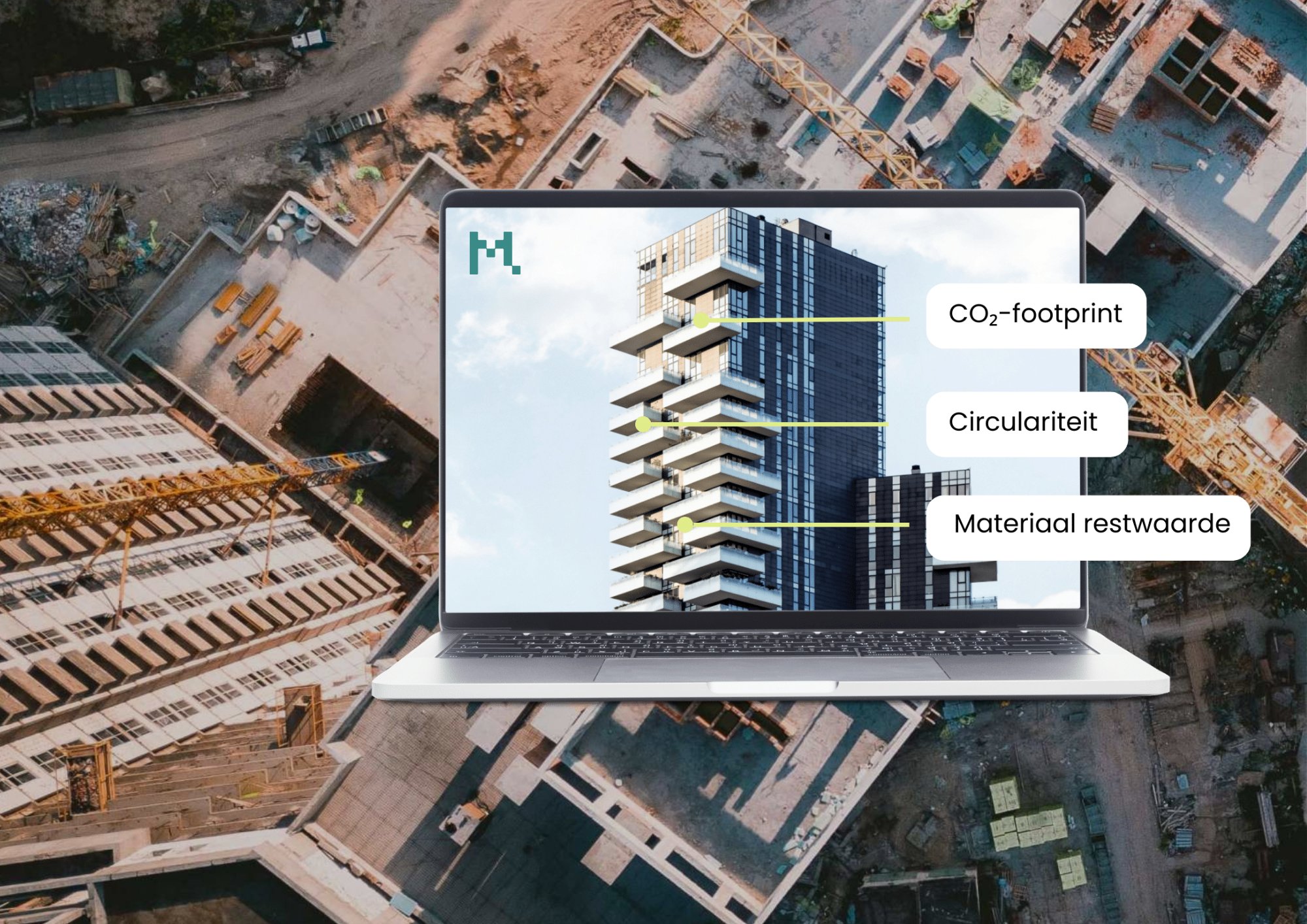
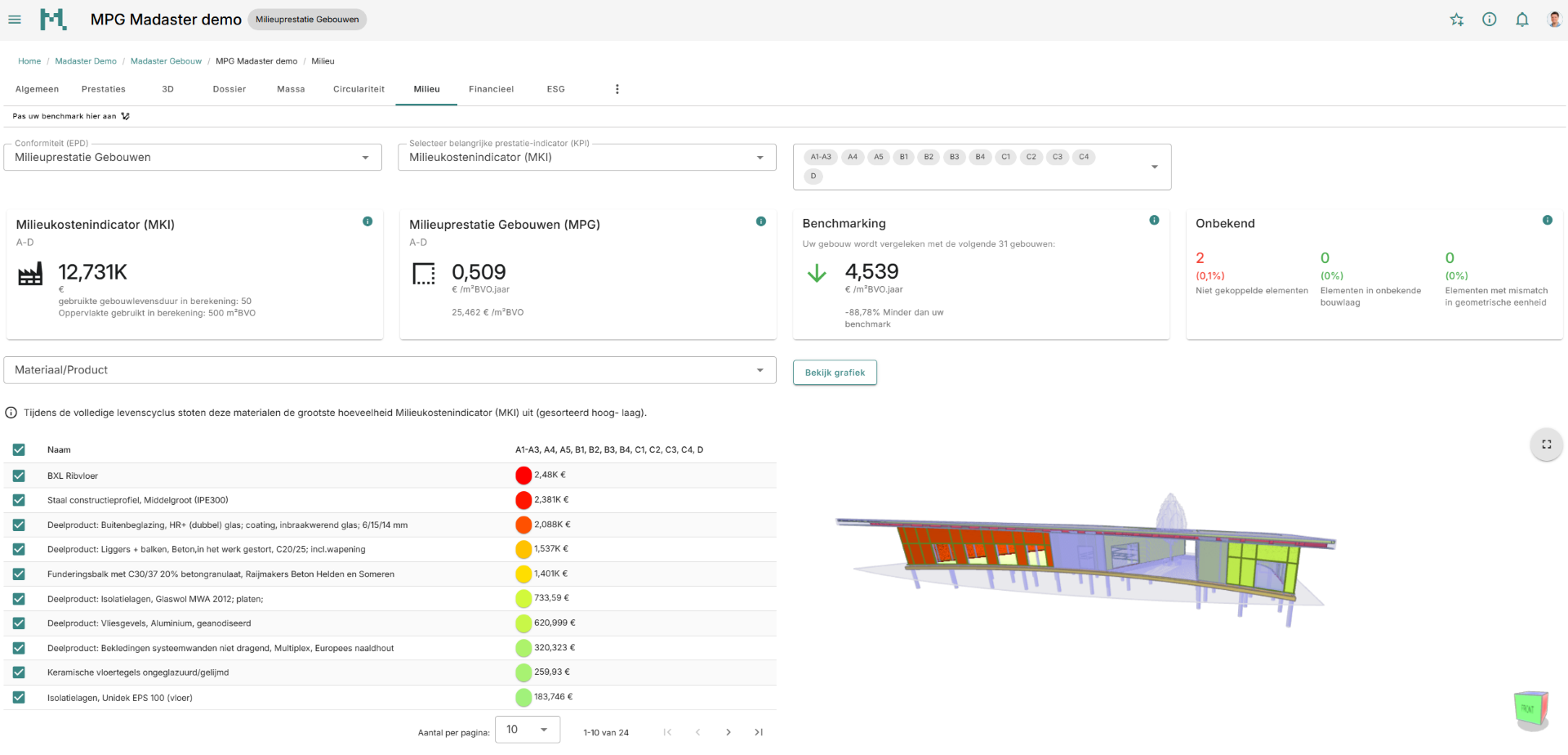
Bram: Madaster distinguishes itself from other calculation tools mainly through the use of Building Information Models (BIM models) to align with the design practices of our clients. This is essentially the starting point for our building calculations. Whether you are focusing on environmental performance calculations (MPG), circularity, or a materials passport, the BIM model forms the basis.
In this respect, Madaster is fundamentally different from a calculation tool where you build a project by manually adding elements. With us, you start with the project you are executing—your own blueprint, so to speak. You then link various elements to it. This can be done in two ways. For example, the NMD works with environmental declarations, each with its own unique number. We can read this environmental declaration number from the BIM model. You can then link the project to this data, allowing you to perform calculations. This also means that the earlier in the process you assign the environmental declaration numbers, the more automated the process becomes. If you then generate an IFC file (Industry Foundation Classes) that we upload, those codes are included.
You can upload this construction drawing as a model into our platform and view it in 3D. You can then inspect classification codes, type names, etc., depending on your design parameters.
However, you can still work with Madaster without an IFC file. With us, you can always add elements afterward using an Excel template.
Madaster and Stichting NMD have now had a collaborative relationship for about 2-3 years. What do you find works well in this partnership, and where do you see room for improvement?
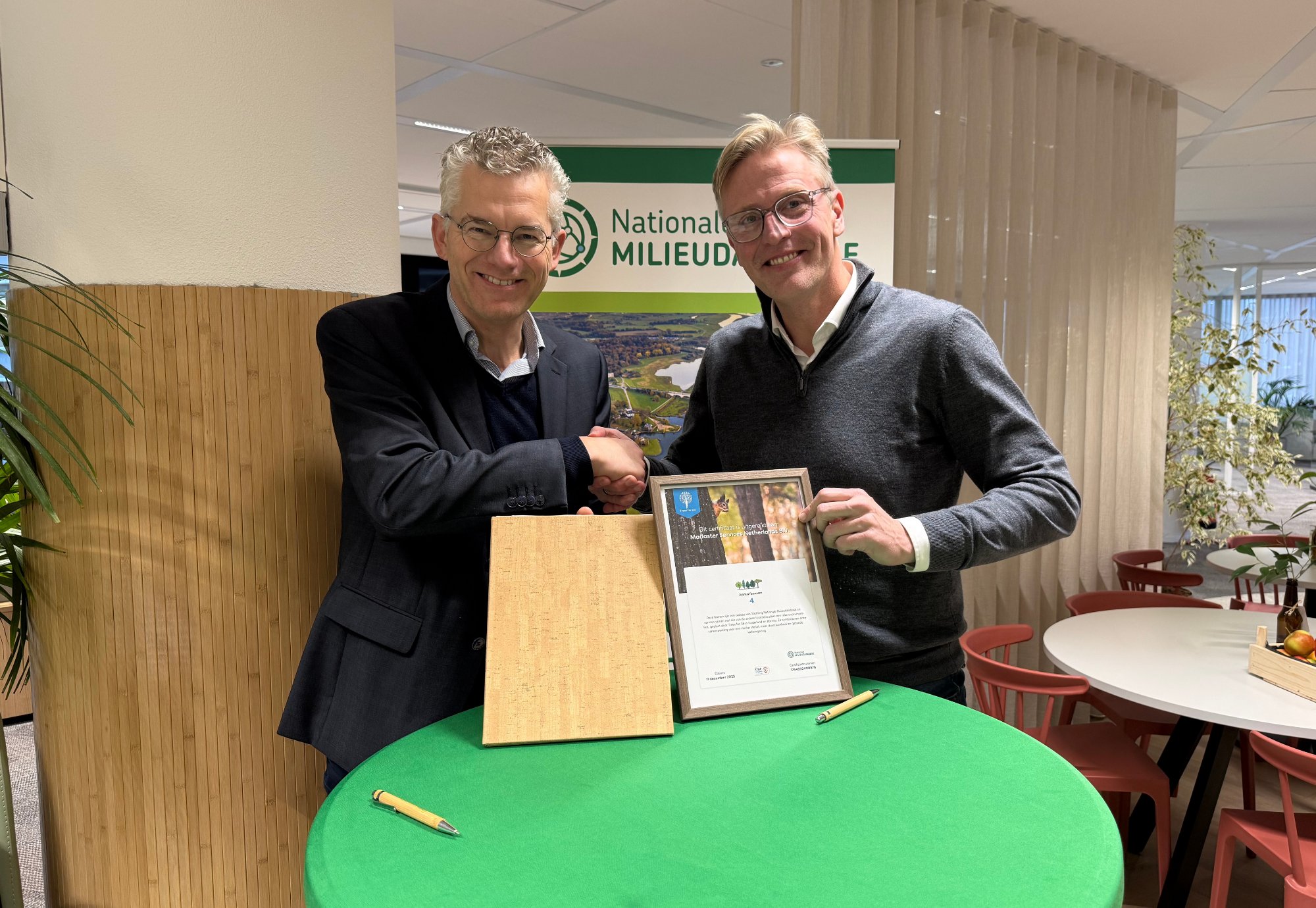
Martijn: I consider it a positive collaboration. That’s also due to the nature of our relationship: you provide the data and its uniformity, and we are the tool. Together, we are ‘part of the solution’ to reduce the environmental impact in the construction sector. I also think Jan-Willem and the team, as an organisation, have made huge strides. In the early days, I found Stichting NMD less professional than it is today. Now, you truly have a strong, professional organisation that holds a much stronger position within the Dutch ecosystem. The database has also been expanded significantly, which is, of course, important. These are crucial aspects for steering the sector in the right direction.
We are, of course, also an international player. We know you operate on the European stage, helping to shape it. We would like to leverage you even more as a knowledge partner in that regard.
Bram: To add to that: I notice that the role of NMD is changing. Stichting NMD is truly becoming the linchpin of the environmental performance system. In that field, there are also parties like RVO and digiGO, so NMD sits between policy and the market. We still need knowledge sharing and support in connecting with the upcoming European developments.
I think Stichting NMD can play an even more facilitating role in this, so that the frameworks become clearer for us.
Can you share any updates on new innovations or adjustments related to policy developments?
Martijn: Absolutely. We were recently validated by Stichting NMD for the MEPG, which is very positive. It’s also worth mentioning that this makes us one of the only two calculation tools in the Netherlands that covers both the MKI and MPG aspects—validated—and also includes both the A1 and A2 sets.
Towards the end of this month, we’ll release a new version of our platform featuring updated dashboarding specifically designed for Het Nieuwe Normaal. We’re proud of that. Additionally, we’ve recently become a solution partner for GRESB, particularly for carbon indicators and embodied carbon.
These are all recent developments, but we also have an innovation in the pipeline. Madaster stands for the cadastre of materials, and this innovation aligns with that mission. We’ve created an environmental register for the entire Netherlands, covering 9 million objects within the Dutch built environment sector. We’ve fully calculated these objects for materialisation and plan to bring this to the market soon. Right now, we’re still looking for pilot projects to test this.
In the Netherlands, we work with the NMD, but in other countries, we rely on different data sources. We, of course, follow the regulations around the CPR (Construction Product Regulation) and the Digital Product Passport (DPP). However, I can’t yet say what the final data landscape will look like. This is crucial for us as a tool, since we depend on that data to deliver valuable insights for our end clients. To put it simply: a single source in Europe for all products would be ideal. Whether that’s realistic, I don’t know—that’s not my battle. But it would certainly add significant value.
What are you most proud of as a calculation tool owner in your collaboration with Stichting NMD?
Bram: I genuinely want to help move the world—and within it, the built environment—forward. But above all, I want sustainability to no longer be seen as a separate issue or an afterthought. I’d love to see not just frontrunners, but all companies integrate environmental insights as rational economic decisions—and obtain those insights through a robust, automated system. That’s why I ended up at Madaster and not somewhere else. So, I’m proud of the fact that we are among the first to enable our clients to access these insights at an early stage and, in doing so, effectively steer towards sustainability.
With our tool, you also gain a steering instrument that allows you to collaborate with the entire supply chain. You can engage with clients and developers early on to align ambitions, ensuring you start the process with the right expectations. This way, you can truly achieve a sustainable design.
What do you see as the added value of a single shared database for environmental performance calculations?
Bram: I think recognition across the entire chain is a crucial point. From my experience—I’m more on the technical side—the most important thing is that a client can factor environmental impact into their decision-making framework. You have price, lead time, and quality; ideally, you want to include environmental impact so you can weigh it properly. A unified database is essential for that. I think that’s one of the most important aspects.
Martijn: I completely agree. Ultimately, you need that single source of truth—a reliable foundation for a common language, enabling exchange, scalability, and mutual comparison to understand exactly how performance is composed. That’s also the value of a single measurement methodology. Together, you become part of the solution. If you measure in one way, things become comparable, and you can collectively assess what is good and what is less so.
Bram: My ideal scenario would be clear rules for setting up a building design. This way, even people who aren’t sustainability experts but are skilled in modeling can still work with this subject matter. In a shared database, you’d ideally have the chain itself working with sustainability, making the translation to practice easier. That might make my own job redundant, but it would be better for the system as a whole.
What message do you want to give your users about your calculation tool?
Martijn: First and foremost, that we are much more than just a materials passport. We cover the entire spectrum (MKI, MPG, A1, A2). Finally, we can also provide evidence that our intention is to broadly promote MKI and MPG calculations and achieve those impact goals. As of January 1, 2026, we’ve decided to move away from the principle of paying per calculation. At Madaster, you pay for a subscription to access the software, and then you can perform as many calculations as you want. The data is growing, the tools are available—so use them and make sure that impact is achieved.
Want to learn more about
Validated calculation tools of the NMD
or Madaster and their calculation tool?
Visit their website:
Read more:


