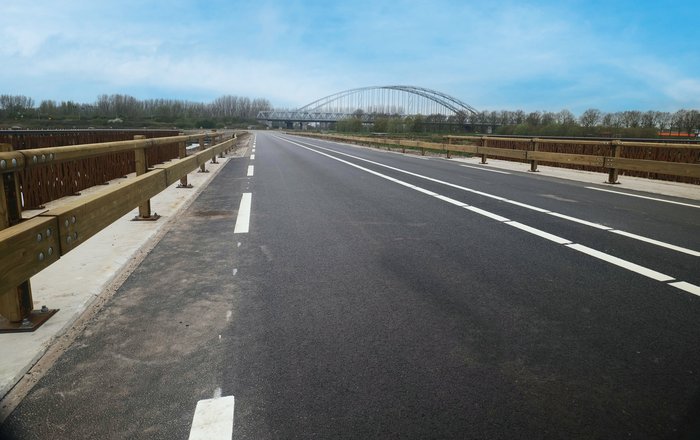
Eurorail
Wood-based guardrails from Eurorail: nine types now included in the Dutch Environmental Database
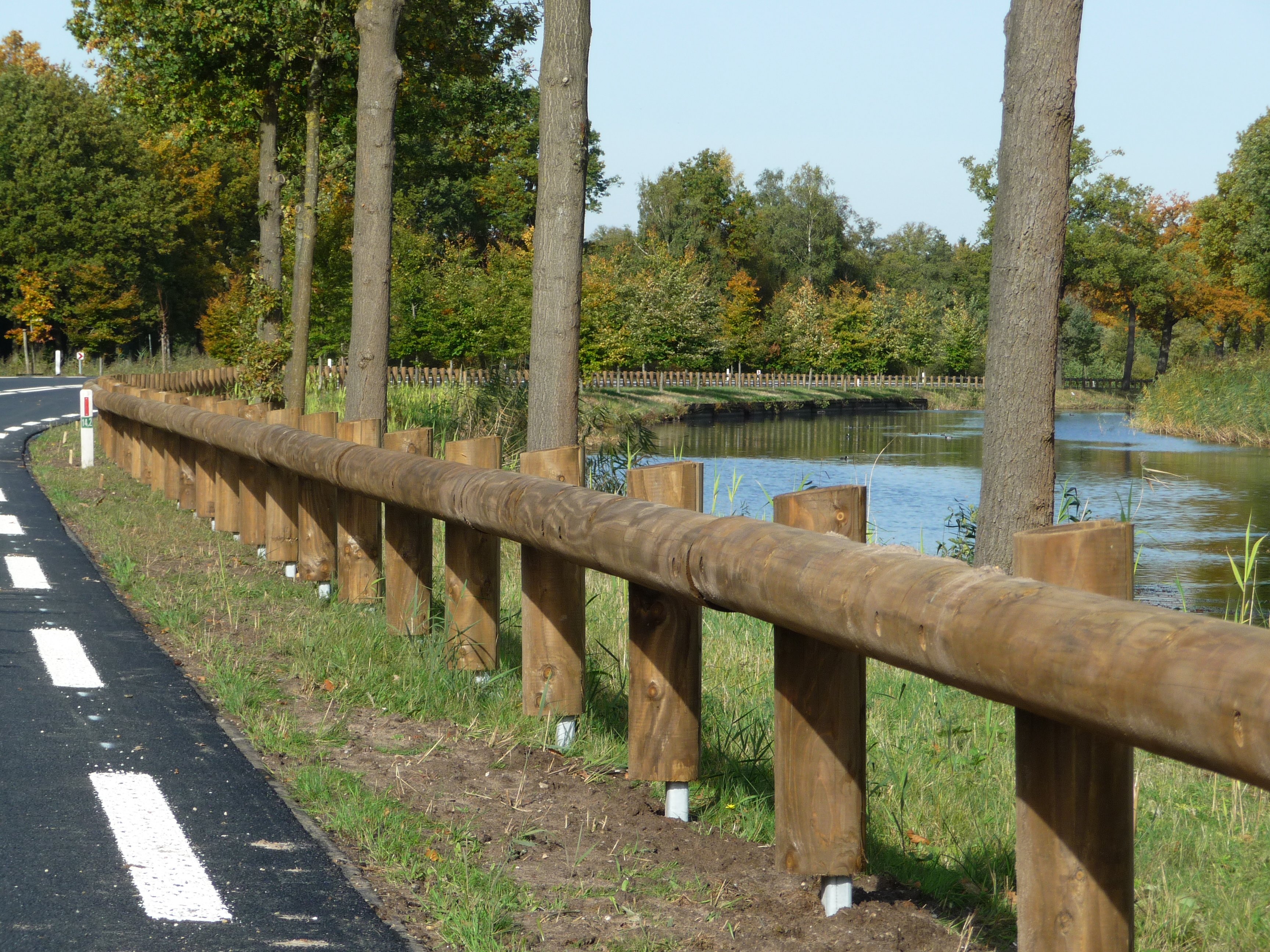
Eurorail has been supplying guardrails along roads since 1978. From 2010 onwards, this also included wooden guardrails for municipal and provincial roads. Because of their appearance, these guardrails have been made with wood from the very beginning. Today, provinces and municipalities increasingly choose this product for sustainability reasons as well. Nine types of wooden guardrails are now listed in the Dutch Environmental Database with a category 1 environmental declaration. Eurorail owner Engel-Jan Timmer explains how the company is continuously working on further sustainability improvements.
It was Engel-Jan Timmer’s father who started Eurorail in the late 1970s. At that time, major motorways in the Netherlands were being extended and expanded. Eurorail supplied and installed guardrails along these motorways. Since the 1980s, the company has also supplied and installed noise barriers, and with the arrival of son Engel-Jan in the company around the year 2000, ‘lighter’ guardrails along provincial roads were added to the portfolio.
For the past two years, Eurorail has been investing significant time in carrying out Life Cycle Assessments (LCAs) for these products. We spoke with Engel-Jan about this work; he has been at the helm of the company since 2007.
Engel-Jan Timmer
Getting started with LCAs
“Around 2010, we indeed started introducing wooden guardrails. Because of their appearance, provinces and municipalities asked us for a different product than what we had previously installed along these roads. At that time, sustainability was not yet a reason to choose wood, but step by step we are seeing that change. That is also the reason why we started working with LCAs.”
Collecting data
“We do not develop the products ourselves. We work closely with factories in France and Italy for this. That is when you notice that we are ahead in the Netherlands. In other countries, something like the MKI is not familiar, and Life Cycle Assessments have only become more widely known in our sector in other European countries in recent years. Our partners were therefore somewhat surprised when we started asking for data. It took some persuasion to bring them along in this. We regularly sat around the table together to discuss it.”
Further developing sustainability
“Ultimately, we have now been working on this for about two years, and nine products are now listed in the Dutch Environmental Database with category 1 data. It did take time, but I can recommend it to everyone. A Life Cycle Assessment gives you a great deal of insight — such as how much energy it takes to produce something, how much environmental impact different materials have, and how much the transport factor contributes to the overall environmental impact.”
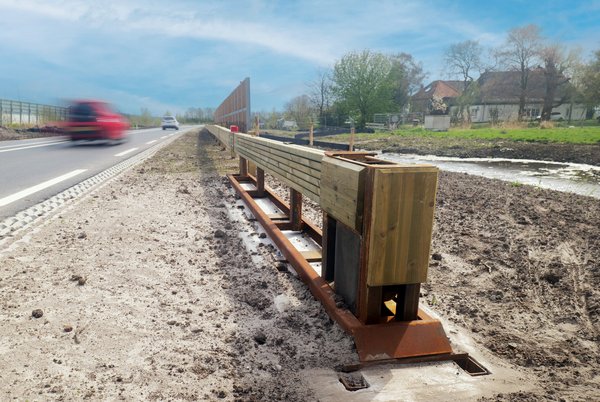
“With those insights, you can develop more consciously. The factories we work with were already investing in energy savings and sustainable energy generation. We are now jointly looking at the composition of the product. For example, can we use a different type of wood? Or treat the wood in a different way so that impregnation is no longer necessary? Can we protect the steel against corrosion in another way, thereby reducing environmental impact?”
“We have also looked into transport. It could be done by water instead of by road. We know this reduces CO₂ emissions, but at the moment it leads to such an increase in costs that it is not yet feasible.”
Making conscious trade-offs
“It is always a continuous balancing of factors. We also want our noise barriers to be included in the Dutch Environmental Database with category 1 data, and then you see the differences in the LCA with regard to service life. If you use biobased materials, the service life may be around 20 to 25 years. When using (recycled) steel and aluminium, this quickly extends to around 50 years.”
“At the same time, wood grows naturally and stores CO₂ during its growth. In addition, we can easily replace the wooden components of our products after the end of their service life, while the steel components last much longer. Ultimately, it is up to our clients to make that trade-off. We provide the insight and explain it — the client makes the choice.”
‘Wow, that’s actually quite low’
Engel-Jan encourages other companies to start working with LCAs. “Here in the Netherlands, we are already quite advanced, but it is inevitable that the rest of Europe will follow quickly. We are glad that we already have experience with it. And the insights it provides are extremely valuable. Gradually, more and more clients are asking about it. We had no idea what MKI values our products would result in, but for many of them we thought: ‘Wow, that’s actually quite positive — that’s fairly low.’ That gives you energy to do even better.”